Pages

Thursday, December 3, 2009

The Collapse Of The Middle Class In The USA


Click here to find out more!
Elizabeth Warren

Elizabeth Warren

Posted: December 3, 2009 10:00 AM

America Without a Middle Class

WHAT'S YOUR REACTION?

Can you imagine an America without a strong middle class? If you can, would it still be America as we know it?

Today, one in five Americans is unemployed, underemployed or just plain out of work. One in nine families can't make the minimum payment on their credit cards. One in eight mortgages is in default or foreclosure. One in eight Americans is on food stamps. More than 120,000 families are filing for bankruptcyevery month. The economic crisis has wiped more than $5 trillion from pensions andsavings, has left family balance sheets upside down, and threatens to put ten million homeowners out on the street.

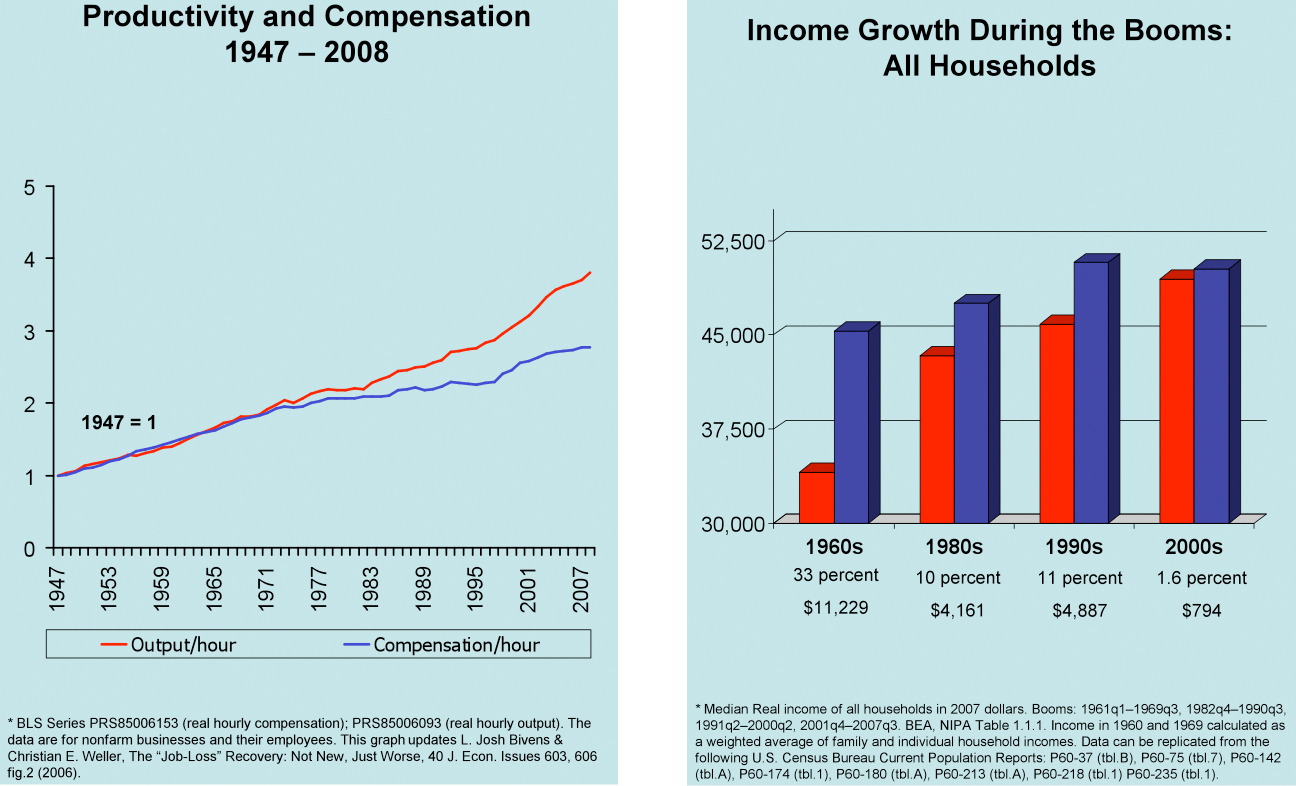
Families have survived the ups and downs of economic booms and busts for a long time, but the fall-behind during the busts has gotten worse while the surge-ahead during the booms has stalled out. In the boom of the 1960s, for example, median family income jumped by 33% (adjusted for inflation). But the boom of the 2000s resulted in an almost-imperceptible 1.6% increase for the typical family. While Wall Street executives and others who owned lots of stock celebrated how good the recovery was for them, middle class families were left empty-handed.

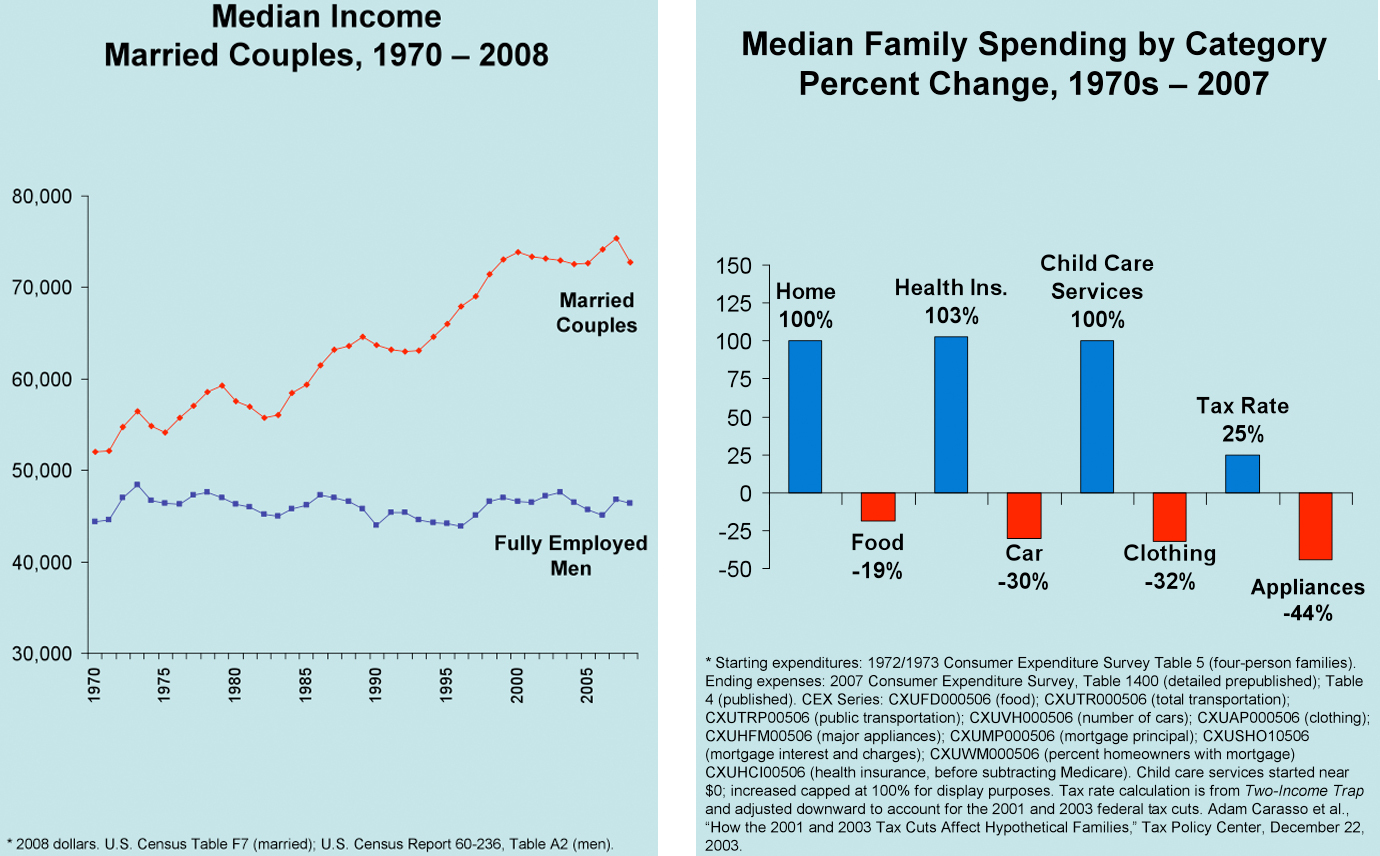
The crisis facing the middle class started more than a generation ago. Even as productivity rose, the wages of the average fully-employed male have been flat since the 1970s.

2009-12-03-warren12.jpg

But core expenses kept going up. By the early 2000s, families were spending twice as much (adjusted for inflation) on mortgages than they did a generation ago -- for a house that was, on average, only ten percent bigger and 25 years older. They also had to pay twice as much to hang on to their health insurance.

To cope, millions of families put a second parent into the workforce. But higher housing and medical costs combined with new expenses for child care, the costs of a second car to get to work and higher taxes combined to squeeze families even harder. Even with two incomes, they tightened their belts. Families today spend less than they did a generation ago on food, clothing, furniture, appliances, and other flexible purchases -- but it hasn't been enough to save them. Today's families have spent all their income, have spent all their savings, and have gone into debt to pay for college, to cover serious medical problems, and just to stay afloat a little while longer.

2009-12-03-warren34.jpg

Through it all, families never asked for a handout from anyone, especially Washington. They were left to go on their own, working harder, squeezing nickels, and taking care of themselves. But their economic boats have been taking on water for years, and now the crisis has swamped millions of middle class families.

The contrast with the big banks could not be sharper. While the middle class has been caught in an economic vise, the financial industry that was supposed to serve them has prospered at their expense. Consumer banking -- selling debt to middle class families -- has been a gold mine. Boring banking has given way to creative banking, and the industry has generated tens of billions of dollars annually in fees made possible by deceptive and dangerous terms buried in the fine print of opaque, incomprehensible, and largely unregulated contracts.

And when various forms of this creative banking triggered economic crisis, the banks went to Washington for a handout. All the while, top executives kept their jobs and retained their bonuses. Even though the tax dollars that supported the bailout came largely from middle class families -- from people already working hard to make ends meet -- the beneficiaries of those tax dollars are now lobbying Congress to preserve the rules that had let those huge banks feast off the middle class.

Pundits talk about "populist rage" as a way to trivialize the anger and fear coursing through the middle class. But they have it wrong. Families understand with crystalline clarity that the rules they have played by are not the same rules that govern Wall Street. They understand that no American family is "too big to fail." They recognize that business models have shifted and that big banks are pulling out all the stops to squeeze families and boost revenues. They understand that their economic security is under assault and that leaving consumer debt effectively unregulated does not work.

Families are ready for change. According to polls, large majorities of Americans have welcomed the Obama Administration's proposal for a new Consumer Financial Protection Agency (CFPA). The CFPA would be answerable to consumers -- not to banks and not to Wall Street. The agency would have the power to end tricks-and-traps pricing and to start leveling the playing field so that consumers have the tools they need to compare prices and manage their money. The response of the big banks has been to swing into action against the Agency, fighting with all their lobbying might to keep business-as-usual. They are pulling out all the stops to kill the agency before it is born. And if those practices crush millions more families, who cares -- so long as the profits stay high and the bonuses keep coming.

America today has plenty of rich and super-rich. But it has far more families who did all the right things, but who still have no real security. Going to college and finding a good job no longer guarantee economic safety. Paying for a child's education and setting aside enough for a decent retirement have become distant dreams. Tens of millions of once-secure middle class families now live paycheck to paycheck, watching as their debts pile up and worrying about whether a pink slip or a bad diagnosis will send them hurtling over an economic cliff.

America without a strong middle class? Unthinkable, but the once-solid foundation is shaking.

Elizabeth Warren is the Leo Gottlieb Professor of Law at Harvard and is currently the Chair of the Congressional Oversight Panel.

Wednesday, December 2, 2009

Dubai Is Not The Last Financial Crisis On The Horizon

ECONOMIC SCENE

A Quaking Brings No Collapse

Published: December 1, 2009

Before the troubles in Dubai, you could reasonably have thought that the financial part of the financial crisis was over.

Related

Times Topics: Dubai

Readers' Comments

Share your thoughts.

Governments around the world took extraordinary steps late last year and early this year to stop a panic, and they largely succeeded. But pumping trillions of dollars into the global financial system did create at least one unavoidable side effect: many of the excesses of the boom years were never quite worked off.

Thanks to low interest rates and other recent policies to support the real estate market, houses in this country are not especially cheap today, compared with incomes or rents. They’re just no longer ridiculously expensive. Stocks were briefly inexpensive last spring, but they are now more expensive than they have been for most of the last 60 years, relative to corporate earnings.

So we should probably expect some more mini-busts — some more Dubais, if you will — in the near future.

As it happens, I was in Dubai just two weeks ago, and I arrived expecting to find a boomtown that had been somewhat humbled. A sort of cross between Las Vegas and Singapore, the city-state had become one of the most obvious symbols of global excess in recent years. Its architectural style may best be described as Modern Hubris: a ski resort was opened inside a shopping mall, and a network of islands were built to resemble a map of the world. When the crisis hit, not surprisingly, cranes were suddenly idled, and hundreds of thousands of migrant workers were forced to leave.

And yet Dubai still feels more like a boomtown than anything else. While taking a walk on a Persian Gulf beach at 6:45 one morning, I could hear clanging coming from a nearby skyscrapers under construction. The migrant workers I met talked about being able to make four times as much as they could in India or Pakistan. A sparkling new subway system had just started running, and the world’s tallest building was nearing completion.

But some of this, we now know, was a result of Dubai’s continuing to live beyond its means. Last week, Dubai World — a government-owned developer and investment company that built those islands in the shape of the world map — announced that it would not be able to repay all its debts. The company has instead asked lenders to accept less money than they are owed. The triggering event seemed to be a $3.5 billion payment due on Dec. 14, the first of about $25 billion in loans that come due over the next three years.

Those loans may not have seemed onerous in the summer of 2008, when a typical square foot of prime Dubai office space was renting for about $130. By this past summer, though, the average had dropped to about $57, according to CB Richard Ellis. (In comparison, the average asking rent today in Manhattan — where there is almost no empty land for new construction — is also about $57 a square foot.)

“Dubai World was facing a cash crunch,” says Kenneth Rogoff, a former chief economist at the International Monetary Fund, “and they couldn’t find someone to help.” Dubai had been relying on neighboring Abu Dhabi, which is also part of the United Arab Emirates and has vastly more oil, for bailouts over the last year. Once Abu Dhabi made clear that its patience was wearing thin, Dubai had to go to its creditors last Wednesday and tell them they wouldn’t be getting all of their money back.

Around the world, financial markets quivered. Market watchers wondered whether investors would flee from anything that looked risky, much as they had after Lehman Brothers collapsed. Obama administration officials spent the Thanksgiving weekend monitoring overseas markets. Economists speculated about which debt-laden country or company might be next.

A week later, I think we can draw two tentative lessons.

First, the financial system is indeed in much better shape than it was early this year. At least so far, almost none of the wider fears have come to fruition.

Stocks around the world have recovered most of their losses since late last week. A more specific measure of investor fears — the TED spread, the difference between the interest rates on interbank loans and on conservative short-term debt issued by the Treasury — looks as if nothing special happened. After rising a bit on Friday, the spread closed on Tuesday at roughly its lowest level in more than a month, 0.21 percent. In October 2008, by contrast, it peaked above 4.5 percent.

The second lesson is that as governments withdraw some of the guarantees they have given financial markets, more flare-ups are bound to happen. Guaranteeing Dubai World’s debt was effectively what Abu Dhabi had been doing. Once it stepped back, there were not enough private investors to fill the void. They were frightened off by Dubai World’s prospects. One of its principal assets, notes Francesco Garzarelli of Goldman Sachs, is “real estate in a place where there has been overconstruction.”

Where might the next flare-up come? A big commercial real estate developer in this country could follow the path of Dubai World and find itself unable to repay debts. Or the housing market could be about to weaken again, as two reports suggested last week. Or stock market investors could decide that the recent rebound — with the Standard & Poor’s 500-stock index up 64 percent since its March low — has been excessive.

Fortunately, the last week has suggested that the world economy might now be able to handle any one of these problems. Dubai was a stress test, and the financial system passed.

Which is all the more reason that policy makers, here and abroad, should continue to shift their focus now. The financial crisis itself was yesterday’s main problem. The fallout from the crisis — starting with unemployment — is today’s.

E-mail: leonhardt@nytimes.com

Tuesday, December 1, 2009

A Happy Pet Story

The moral of this story is the best part!!!

Debby Cantlon, who plans to release Finnegan, the young squirrel, back into the wild, bottle-fed the infant squirrel after it was brought to her house.
cid:D492B1F34BE54E24B2BC13229611519C@Bob
When Cantlon took in the tiny creature and began caring for him, she found herself with an unlikely nurse's aide: her pregnant Papillion, Mademoiselle Giselle.


cid:3AA08ACD40434D7298F74F56D0FAA604@Bob
Finnegan was resting in a nest in a cage just days before Giselle was due to deliver her puppies.


cid:2042689F255E4968BE409764146BA37B@Bob
Cantlon and her husband watched as the dog dragged the squirrel's cage twice to her

own bedside before she gave birth.


cid:18919E8907F740CC9A1E87F605FBA2E4@Bob
Cantlon was concerned, yet ultimately decided to allow the squirrel out and the inter-species bonding began.


cid:F43D45A809C4485190F8FFED3E79C4E1@Bob
Finnegan rides a puppy mosh pit of sorts, burrowing in for warmth after feeding, eventually working his way beneath his new litter mates.


cid:BC2E0B21915B42388297F1078DE2C34A@Bob
Two days after giving birth, mama dog Giselle allowed Finnegan to nurse; family photos and a videotape show her encouraging him to suckle alongside her litter of five pups.

Now, Finnegan mostly uses a bottle, but still snuggles with his 'siblings' in a
moshpit of puppies,
rolling atop their bodies, and sinking in deeply for a nap.


cid:C1BFE3A4FA27473C86221A8802F707EF@Bob
Finnegan and his new litter mates, five Papillion puppies, get along together as if they were meant to.


cid:C3D4660D51174DB1816026FC7BB86BE5@Bob
Finnegan naps after feeding.


cid:403DF1AB462943D68BCFF975CF89F161@Bob
Finnegan makes himself at home with his new litter mates, nuzzling nose-to-nose for a nap after feeding.

Send this along to brighten someone's day!
Wouldn't it be nice if we could all get along
like Finnegan and the gang?

MORAL OF THE STORY: Keep loving everyone, even the squirrelly ones
...