This page was produced by FT2, the advertising department of the Financial Times. The news and editorial staff of the Financial Times had no role in its preparation.
DISCOVER A GREAT LIFE... AT THE EDGE OF THE MAP
For most people who move there, the allure of New Zealand is its phenomenal variety. You can quickly slip from sophisticated urban culture into charming countryside, or discover a genuine wilderness, strongly protected by environmental legislation. In a land area about the same as the UK are fjords, glaciers, thermal resorts, island hideaways and a mighty chain of mountains.
New Zealand offers an enviable lifestyle – and you’ll find it’s just as easy to do business. You can grow your business in an environment with low corruption, strong institutions, settled markets, fresh attitudes, political and economic stability and a culture of entrepreneurship. It comes first for both ease of both doing business and starting a business in the World Bank 2017 rankings. Seemingly, all the world’s surveys of lifestyle and desirability are enthusiastic about New Zealand, and the liveability of its burgeoning biggest city, Auckland, sprawling between two big harbours with a gulf full of islands, and marinas bursting with boats ready for summers of warm winds.
‘For most people who move there, the allure of New Zealand is its phenomenal variety’
Why do people come, when they are successful back home? Liverpool-born author Nicky Pellegrino appreciates “the benefits of a big city (Auckland) without that feeling of being hemmed in back in London. I have two horses and there is room to ride them.”
Once upon a time this country’s distance from everywhere else was a problem. Now, it’s an advantage. Businessman Forbes Elworthy and his wife Bridget live mostly in Oxfordshire, but their Craigmore Station in New Zealand’s South Canterbury is also a central part of their lives. Forbes was a trader at Merrill Lynch once. He praises the insulation that distance brings “from the economic fashions and gyrations of the north.”
‘Almost three-quarters of expats reported an improved quality of life in a recent HSBC survey’
Peter Haughton emigrated from the UK to settle in Arrowtown, a historic gold-mining village near Queenstown, bordering a championship golf course. Haughton was with JP Morgan Chase for 19 years, and is now on three boards as a company director. “New Zealand is amazing for the children,” he says. “Compared with central London they have a much broader experience. Outdoor adventure at school here is amazing, and the general education is good.”
Two centuries on from European settlement New Zealand is again the land of opportunity. PayPal co-founder Peter Thiel has been a major investor, praising the country’s potential as a tech hub. He is not the only one. Hong Kong-based financier Michael Nock from investment house Doric Capital said earlier this year: “The thing that was always working against New Zealand – the tyranny of distance – is the very thing that becomes its strength as the world becomes more uncertain,” he says.
‘Angel investment activity in New Zealand has trebled in the last decade, and the country now has more angel investors per capita than the US’
Another strength is that the country lives up to expectations. Almost three-quarters of expats reported an improved quality of life in a recent HSBC survey. The number for their children was even higher at 85 per cent. Hospital healthcare is free; so is state schooling up until tertiary level.
Migrant investors are welcome, and unconditional residence can be granted to applicants after three years in some cases. On its high streets and in its malls, UK and US migrants mingle with newer citizens from South Africa, China and India. They come to the most prosperous nation on earth now, according to the annual survey by the Legatum Institute, a think-tank. New Zealand has been number one for six of the last ten years, with Legatum citing “Free markets, free people, and the world’s strongest society.”
It also ranked as the world’s freest economy in the Heritage Foundation’s 2015 Index of Economic Freedom. Angel investment activity in New Zealand has trebled in the last decade, and the country now has more angel investors per capita than the US.
Forbes Elworthy points to the fact that everyone who inhabits New Zealand has travelled to it. “Everybody brings a lot with them, from their own traditions, and they help refresh the country,” he says.
New Zealand seems to offer a lot to many of the world’s wealthy and well-qualified. It provides sanctuary for them and solutions for their investment needs. The connectivity of our age has banished its historical isolation, while many of the problems of the present world still seem thousands of miles away.
With so many great reasons to move yourself and your family to New Zealand, perhaps the real question is: Why not?
David
Whitten is a great lawyer who represented me in a tough case 15 years ago. He
pulled off a miracle in negotiations. I
didn’t have the cash to make the miracle happen. On a personal level, I tell
David that he should get the Academy Award for being the world’s best dad. He
and his dear wife raised their own kids and have adopted many more children,
including those with special needs. I can’t say enough nice things about David.
David took
strong exception to my prediction that Donald Trump would use nuclear weapons
in North Korea. He claims that the Chinese would retaliate and it would cause
World War III. I have evidence that refutes this.
A few days
ago, I talked about North Korea. I raised a simple common sense question that
no one has stepped up to answer yet. The question is as follows:
“Iran has
tens of billions of dollars in oil revenues. Yet they have not been able to
build a nuclear warhead. North Korea is dead broke and cannot even feed their
population. Yet they have been able to develop multiple nuclear warheads, Some
pretty-advanced delivery systems, etc. Who is putting up the money to make this
happen?”
When it
comes to providing the financing, four suspects come to light as follows:
China: Elena
suspects them. I do not. Whether you like Henry Kissinger or not, he is truly
the one Western man who understands China. He wrote a book about China that is
long and involved. Please find the time to read it. After reading this book I
think that the Chinese would be much too cautious and responsible ever to do
such a thing.
Pakistan:
One hears all sorts of stories about radical Muslims and the fear or Pakistani
nuclear technology and weapons being sold to terrorists. I have personal experience
dealing with very legitimate large private companies in Pakistan. They are true
professionals. They run excellent companies that are 100% honest. Prudent and
careful investments there will yield good returns. I have seen interviews
with senior officials at the US Embassy to Pakistan. They uniformly praise the
Pakistan military and the security that it maintains over nuclear weapons. I
reject them as a suspect.
Iranian Hard
Liners: The Revolutionary Guards similar groups might be financing North Korean
nuclear weapons programs. Of course, the questions comes to mind: “If they have
put up the money why haven’t they received a nuclear war head?”
Wealthy
Jihadist financing ISIS and other terrorist groups. These are my prime
suspects. What do they want for the big investment? The answer is straight
forward. They want to create a department store (ie: Macy’s Dillard’s, etc) for
nuclear warheads. North Korea will be the “go to” place for terrorists to
purchase nuclear warheads and radiological materials for “dirty bombs.”
The military
and intelligence authorities in several countries know about this danger.
Stratfor is the best civilian intelligence agency on planet earth. They already
have published a creditable war plan using very-advanced conventional weapons
to destroy North Korea’s nuclear capability:
Nowhere in
this analysis do the Stratfor people see any probability of a Chinese military
response to such an attack.
Now we add
Donald Trump into the equation. During his campaign for president he repeated
presented the question: “Why can’t I use nuclear weapons?” All other US
president in recent history consider a nuclear first-strike of any kind taboo.
Richard M. Nixon was the one exception. He wanted to employ nuclear weapons
against North Vietnam and North Korea. Henry Kissinger blocked all these
attempts to use nuclear weapons. Donald Trump has a national security advisor,
General Flynn, just like him-short tempered and vindictive.
Kim Jun Un
is going to underestimate Trump. He will challenge Trump and provoke him to
action. Trump will have a look at the war plan in place to destroy North Korea’s
nuclear capabilities. Trump will quickly come to the conclusion that such an
attack would leave Kim Jun Un in place with many military capabilities. Trump
and General Flynn will choose tactical nuclear weapons to destroy North Korea’s
military and affect a regime change there. A surprise nuclear attack will
follow.
Will China
retaliate with nuclear weapons? I think not. China has strict rules of
engagement for the use of nuclear weapons. To make a long story short, China
will only use nuclear weapons if a nuclear weapon is detonated above or on
Chinese territory. China does not consider North Korea Chinese territory.
What are the
consequences of such a nuclear strike? Financial markets will tumble and
investors will suffer short-term losses. You will have a huge refugee problem
like we have in Syria now. China and South Korea will be “stuck with the bill
for this mess.” Trump will pay nothing. South Korea will suffer serious damage
as the remnants of the North Korean military machine attack Seoul. Again,
Donald Trump will pay nothing to repair these damages.
There will
be huge and violent protests worldwide. Trump will be compared to Adolf Hitler.
A precedent will also be set where any country with nuclear weapons can make a
first strike if tensions arise.
It is not true that humanity cannot learn from history. It can and, in the case of the lessons of the dark period between 1914 and 1945, the west did. But it seems to have forgotten those lessons. We are living, once again, in an era of strident nationalism and xenophobia. The hopes of a brave new world of progress, harmony and democracy, raised by the market opening of the 1980s and the collapse of Soviet communism between 1989 and 1991, have turned into ashes.
What lies ahead for the US, creator and guarantor of the postwar liberal order, soon to be governed by a president who repudiates permanent alliances, embraces protectionism and admires despots? What lies ahead for a battered EU, contemplating the rise of “illiberal democracy” in the east, Brexit and the possibility of Marine Le Pen’s election to the French presidency?
What lies ahead now that Vladimir Putin’s irredentist Russia exerts increasing influence on the world and China has announced that Xi Jinping is not first among equals but a “core leader”?
The contemporary global economic and political system originated as a reaction against the disasters of the first half of the 20th century. The latter, in turn, were caused by the unprecedented, but highly uneven, economic progress of the 19th century.
The transformational forces unleashed by industrialisation stimulated class conflict, nationalism and imperialism. Between 1914 and 1918, industrialised warfare and the Bolshevik revolution ensued. The attempted restoration of the pre-first world war liberal order in the 1920s ended with the Great Depression, the triumph of Adolf Hitler and the Japanese militarism of the 1930s. This then created the conditions for the catastrophic slaughter of the second world war, to be followed by the communist revolution in China.
In the aftermath of the second world war, the world was divided between two camps: liberal democracy and communism. The US, the world’s dominant economic power, led the former and the Soviet Union the latter. With US encouragement, the empires controlled by enfeebled European states disintegrated, creating a host of new countries in what was called the “third world”.
Contemplating the ruins of European civilisation and the threat from communist totalitarianism, the US, the world’s most prosperous economy and militarily powerful country, used not only its wealth but also its example of democratic self-government, to create, inspire and underpin a transatlantic west. In so doing, its leaders consciously learnt from the disastrous political and economic mistakes their predecessors made after its entry into the first world war in 1917.
Domestically, the countries of this new west emerged from the second world war with a commitment to full employment and some form of welfare state. Internationally, a new set of institutions — the International Monetary Fund, the World Bank, the General Agreement on Tariffs and Trade (ancestor of today’s World Trade Organisation) and the Organisation for European Economic Co-operation (the instrument of the Marshall Plan, later renamed the Organisation for Economic Co-operation and Development) — oversaw the reconstruction of Europe and promoted global economic development. Nato, the core of the western security system, was founded in 1949. The Treaty of Rome, which established the European Economic Community, forefather of the EU, was signed in 1957.
This creative activity came partly in response to immediate pressures, notably the postwar European economic misery and the threat from Stalin’s Soviet Union. But it also reflected a vision of a more co-operative world.
From euphoria to disappointment
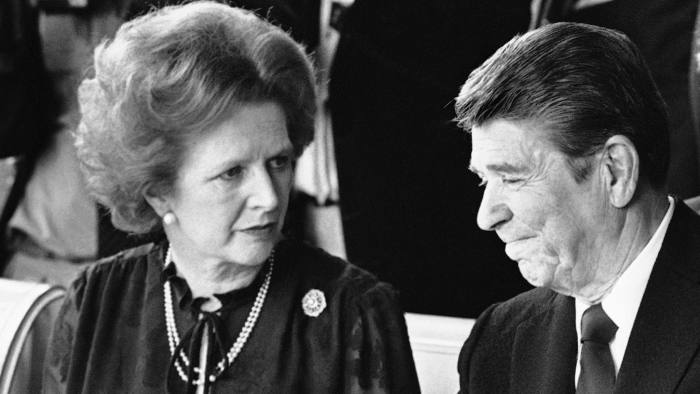
Economically, the postwar era can be divided into two periods: the Keynesian period of European and Japanese economic catch-up and the subsequent period of market-oriented globalisation, which began with Deng Xiaoping’s reforms in China from 1978 and the elections in the UK and US of Margaret Thatcher and Ronald Reagan in 1979 and 1980 respectively.
This latter period was characterised by completion of the Uruguay Round of trade negotiations in 1994, establishment of the WTO in 1995, China’s entry into the WTO in 2001 and the enlargement of the EU, to include former members of the Warsaw Pact, in 2004.
The first economic period ended in the great inflation of the 1970s. The second period ended with the western financial crisis of 2007-09. Between these two periods lay a time of economic turmoil and uncertainty, as is true again now. The main economic threat in the first period of transition was inflation. This time, it has been disinflation.
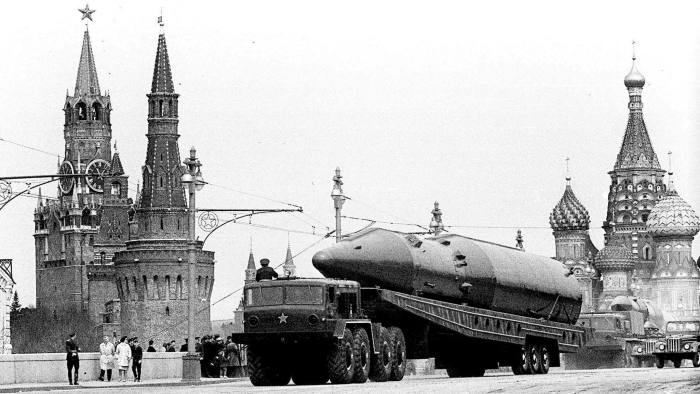
Geopolitically, the postwar era can also be divided into two periods: the cold war, which ended with the Soviet Union’s fall in 1991, and the post-cold war era. The US fought significant wars in both periods: the Korean (1950-53) and Vietnam (1963-1975) wars during the first, and the two Gulf wars (1990-91 and 2003) during the second. But no war was fought among economically advanced great powers, though that came very close during the Cuban missile crisis of 1962.
The first geopolitical period of the postwar era ended in disappointment for the Soviets and euphoria in the west. Today, it is the west that confronts geopolitical and economic disappointment.
The Middle East is in turmoil. Mass migration has become a threat to European stability. Mr Putin’s Russia is on the march. Mr Xi’s China is increasingly assertive. The west seems impotent.
These geopolitical shifts are, in part, the result of desirable changes, notably the spread of rapid economic development beyond the west, particularly to the Asian giants, China and India. Some are also the result of choices made elsewhere, not least Russia’s decision to reject liberal democracy in favour of nationalism and autocracy as the core of its post-communist identity and China’s to combine a market economy with communist control.
Rising anger
Yet the west also made big mistakes, notably the decision in the aftermath of 9/11 to overthrow Iraqi leader Saddam Hussein and spread democracy in the Middle East at gunpoint. In both the US and UK, the Iraq war is now seen as having illegitimate origins, incompetent management and disastrous outcomes.
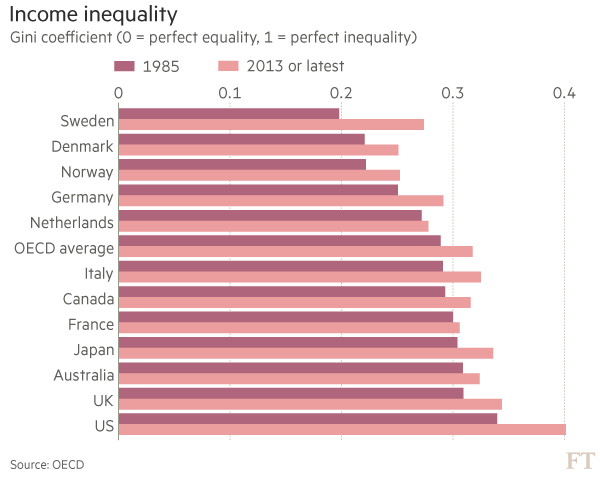
Western economies have also been affected, to varying degrees, by slowing growth, rising inequality, high unemployment (especially in southern Europe), falling labour force participation and deindustrialisation. These shifts have had particularly adverse effects on relatively unskilled men. Anger over mass immigration has grown, particularly in parts of the population also adversely affected by other changes.
Some of these shifts were the result of economic changes that were either inevitable or the downside of desirable developments. The threat to unskilled workers posed by technology could not be plausibly halted, nor could the rising competitiveness of emerging economies. Yet, in economic policy, too, big mistakes were made, notably the failure to ensure the gains from economic growth were more widely shared. The financial crisis of 2007-09 and subsequent eurozone crisis were, however, the decisive events.
These had devastating economic effects: a sudden jump in unemployment followed by relatively weak recoveries. The economies of the advanced countries are roughly a sixth smaller today than they would have been if pre-crisis trends had continued.
The response to the crisis also undermined belief in the system’s fairness. While ordinary people lost their jobs or their houses, the government bailed out the financial system. In the US, where the free market is a secular faith, this looked particularly immoral.
Finally, these crises destroyed confidence in the competence and probity of financial, economic and policymaking elites, notably over the management of the financial system and the wisdom of creating the euro.
All this together destroyed the bargain on which complex democracies rest, which held that elites could earn vast sums of money or enjoy great influence and power as long as they delivered the goods. Instead, a long period of poor income growth for most of the population, especially in the US, culminated, to almost everyone’s surprise, in the biggest financial and economic crisis since the 1930s. Now, the shock has given way to fear and rage.
The succession of geopolitical and economic blunders has also undermined western states’ reputation for competence, while raising that of Russia and, still more, China. It has also, with the election of Donald Trump, torn a hole in the threadbare claims of US moral leadership.
We are, in short, at the end of both an economic period — that of western-led globalisation — and a geopolitical one — the post-cold war “unipolar moment” of a US-led global order.
The question is whether what follows will be an unravelling of the post-second world war era into deglobalisation and conflict, as happened in the first half of the 20th century, or a new period in which non-western powers, especially China and India, play a bigger role in sustaining a co-operative global order.
Free trade and prosperity
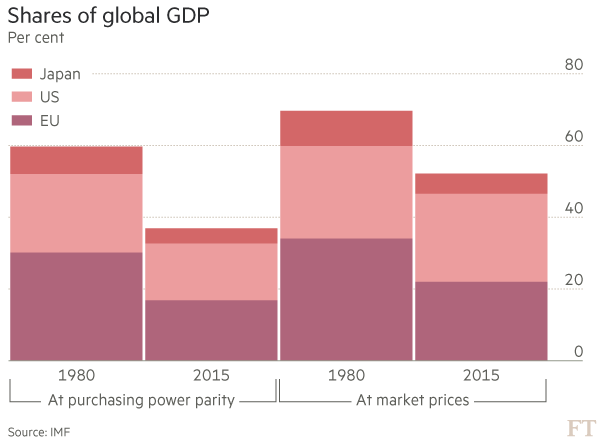
A big part of the answer will be provided by western countries. Even now, after a generation of relative economic decline, the US, the EU and Japan produce just over half of world output measured at market prices and 36 per cent of it measured at purchasing power parity.
They also remain homes to the world’s most important and innovative companies, dominant financial markets, leading institutions of higher education and most influential cultures. The US should also remain the world’s most powerful country, particularly militarily, for decades. But its ability to influence the world is greatly enhanced by its network of alliances, the product of the creative US statecraft during the early postwar era. Yet alliances also need to be maintained.
The essential ingredient in western success must, however, be domestic. Slow growth and ageing populations have put pressure on public spending. With weak growth, particularly of productivity, and structural upheaval in labour markets, politics has taken on zero-sum characteristics: instead of being able to promise more for everybody, it becomes more about taking from some to give to others. The winners in this struggle have been those who are already highly successful. That makes those in the middle and bottom of the income distribution more anxious and so more susceptible to racist and xenophobic demagoguery.
In assessing responses, two factors must be remembered.
First, the post-second world war era of US hegemony has been a huge overall success. Global average real incomes per head rose by 460 per cent between 1950 and 2015. The proportion of the world’s population in extreme poverty has fallen from 72 per cent in 1950 to 10 per cent in 2015.
Globally, life expectancy at birth has risen from 48 years in 1950 to 71 in 2015. The proportion of the world’s people living in democracies has risen from 31 per cent in 1950 to 56 per cent in 2015.
Second, trade has been far from the leading cause of the long-term decline in the proportion of US jobs in manufacturing, though the rise in the trade deficit had a significant effect on employment in manufacturing after 2000. Technologically driven productivity growth has been far more powerful.
Similarly, trade has also not been the main cause of rising inequality: after all, high-income economies have all been buffeted by the big shifts in international competitiveness, but the consequences of those shifts for the distribution of income have varied hugely.
US and western leaders have to find better ways to satisfy their people’s demands. It looks, however, as though the UK still lacks a clear idea of how it is going to function after Brexit, the eurozone remains fragile, and some of the people Mr Trump plans to appoint, as well as Republicans in Congress, seem determined to slash the frayed cords of the US social safety net.
A divided, inward-looking and mismanaged west is likely to become highly destabilising. China might then find greatness thrust upon it. Whether it will be able to rise to a new global role, given its huge domestic challenges, is an open question. It seems quite unlikely.
By succumbing to the lure of false solutions, born of disillusion and rage, the west might even destroy the intellectual and institutional pillars on which the postwar global economic and political order has rested. It is easy to understand those emotions, while rejecting such simplistic responses. The west will not heal itself by ignoring the lessons of its history. But it could well create havoc in the attempt.
We are getting very close to the inauguaration day and I see these things coming: 1) Unknown to most people Mexico has the 4th largest car manufacturing industry in the world. Trump will void NAFTA and put huge import duties on cars made in Mexico being imported to the US. Unless these Mexican car manufacturers have another place to sell the cars they will shut down. Canada may get hit with this also but it will not hurt them in the same way. 2) China is in big problems as Trump sees them as the one country cheating us the most. Look for a 45% duty on goods imported from China. This will cause big problems and tensions. 3) Kim Jun Un and the North Korean gangsters are going to blatantly and openly "jump in the face of Trump" and challenge him over nuclear weapons. You are going to see nuclear weapons used for the first time in combat since 1945. The US has the firepower to destroy the North Korean military machine. We will see cyber attacks here and terrorists attacks in retaliation. This will cause a new Cold War between China and the US. 3) Trump sincerely wants to produce a new health care program where no one loses their insurance coverage. Despite his best intentions, the very ill and vulnerable will lose coverage. In rich states like California, the states will take over paying for this coverage. In red states that are without a lot of money, many people will have very poor or no medical coverage. Sick people will die. 4) Putin has "painted himself into a corner over election hacking. This will make it difficult for Trump to develop a close working relationship with him.(In public anyway.)
January is the time for new year resolutions to conquer addictions: give up alcohol, eat less, stop checking Facebook and Twitter as often, and so on. But what if the addiction is collective — it cannot be kicked by one individual while others are still abusing?
Email is a prime example, as a French law that came into force this week recognises. The law is intended to give employees the “right to disconnect” by making large companies negotiate with their staff times when they are not expected to pick up their smartphones and answer messages. This promises the digital equivalent of clocking out from a factory.
It is easy to poke holes in this dirigiste approach from the country that imposed a maximum 35-hour working week. The ability to leave the office and stay in touch can be a boon for professionals: it is better than having to hang around in case the boss wants you. And what about time zones? Should staff in Hong Kong be able to ignore inconvenient emails from New York?
But the French government is right in a couple of important respects. First, email and other forms of digital communication, from corporate social media to messaging tools such as Slack, can erode the boundary between work and personal life in harmful ways. Second, it is a collective challenge: it is hard for one person to ignore emails as long as others keep sending them.
Companies and employees are codependent on email and other forms of digital sprawl such as global conference calls, on which hours are wasted invisibly. The worst offender is often not the enterprise itself but power-hungry middle managers who consume staff time without it appearing on time sheets.
Like pollution, this has a collective cost but not one that is easily accounted for. The immediate impact is on individuals who do not detach from thinking about work except when they are asleep. The continuous, always-on nature of digital communication — emails could pop into your inbox at any time — makes it hard to switch off awareness and gain repose.
Work email is a nasty form of addiction because it does not provide much pleasure, unlike other kinds of digital communication, such as posting on social media. We may regret spending too much time on Instagram, Pinterest, Snapchat and the rest but they do offer a reward in the form of amusement, entertainment, flirtation, boasting and interaction with friends.
Emails are more of a duty: they have to be read and acknowledged if you want to stay in the loop. One study found that 70 per cent of emails were opened within six secondsat work, and it took a minute per interruption for the recipient fully to regain concentration. That is an awful lot of business disruption, given that 120bn work emails are expected to be sent and received daily in 2017.
When the habit extends beyond office hours, the loss of detachment can become pernicious. Another study of about 300 employees in different industries found that the inability to disengage caused “chronic stress and emotional exhaustion” among some, although others coped better.
Most employers are happy to put managers and professionals under stress, provided it does not get out of hand. Many “high-performance” workplaces are designed to operate like this. But chronic overwork caused by not allowing breaks from work has a clear impact on productivity: tired and jaded employees produce less.
This sounds obvious; it is also well documented. A study of first world war munitions workers in the UK found that if they worked excessive hours one week, their productivity suffered the next. More recently, pre-school teachers in Germany were found to be happier and more effective in class if they had taken the weekend off.
Limiting work used to be simple: it was just a matter of imposing shorter shifts. The seamless, addictive nature of digital communication makes it harder. But companies have a stake in realising “how damaging social media and tech addiction can be”, as Adam Alter, author of Irresistible, a forthcoming book on digital addiction, argues.
France’s new law is well designed in asking companies and employees to work out the right solution for themselves. Some organisations are highly distributed and employ many self-directing professionals who prefer to spread their work out without being physically overseen. If email lets them work efficiently from home, it would be stupid to block them.
But email easily becomes a collective addiction. It suits some executives to dispatch batches of emails late at night, perhaps after their children are in bed, but the same messages can create a stressful interruption for the recipients who are expected to respond. The stress falls on employees but the cost in lower productivity eventually works its way through to their employer.
Collective New Year resolutions to alter behaviour may have no more chance of lasting than individual vows; they are probably even harder to keep. But making a resolution is a start.