
Life takes us in many strange directions and wonderful discoveries. It never turns out the way we thought it would.
Tuesday, July 9, 2019
What A Glorious Day!!
Amy McGrath Jumps Into Senate Race To Replace Mitch McConnell
https://www.huffpost.com/entry/amy-mcgrath-mitch-mcconnell-kentucky-senate_n_5d247979e4b0583e48274251

Friday, July 5, 2019
Before America Got Uncle Sam It Had To Endure Brother Jonathan
Before America Got Uncle Sam, It Had to Endure Brother Jonathan
Brash, bold, and bigoted, he made for an uneasy national mascot.
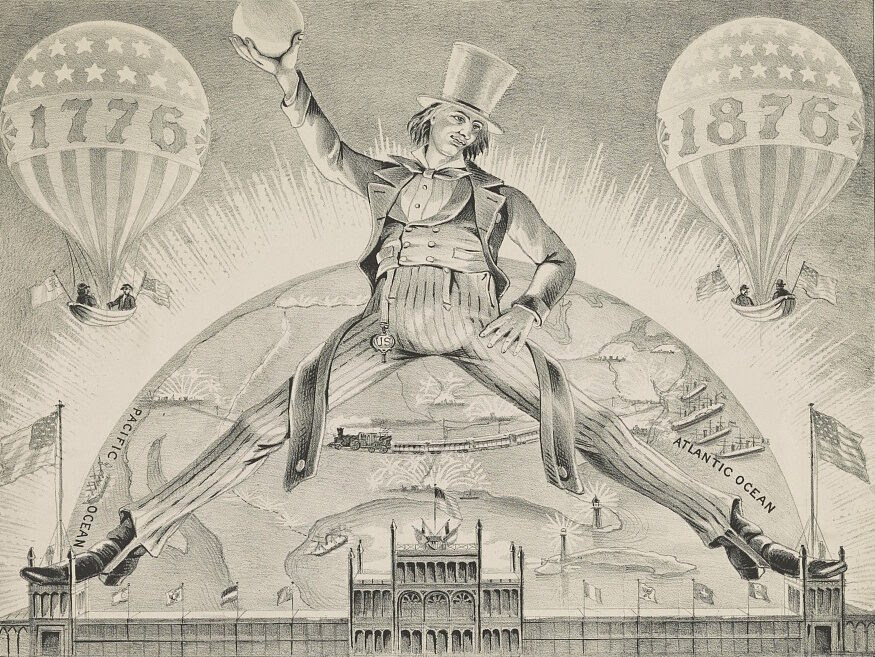
Brother Jonathan celebrates the American centenary by straddling the towers of the main building at the Philadelphia World's Fair of 1876
He was ill-mannered and ill-spoken—a boor, a braggart, a ruffian, a bigot, a hick, and a trickster. His name was Brother Jonathan.
Today he is all but forgotten—eclipsed by his upstanding uncle, Sam. But after the Revolutionary War, Brother Jonathan was the personification of the newly independent American people: clever, courageous, not all that sophisticated and proud of it. He was the everyman incarnate. It was the everyman who had led America to victory. And now America looked to the everyman to lead them out from the bloated shadow of Great Britain.
During the nation’s first hundred years, America tried on many characters in search of the perfect fit for its new independent status. There was the feminine Columbia, the indigenous bald eagle, the stoic Lady Liberty, and the bumbling Yankee Doodle. Out of this personification soup, only a few emerged that had some staying power.
Many of these national stereotypes were depicted in popular ballads and stage comedies before America had even achieved its independence; Yankee Doodle was among them. He was originally a British invention—a caricature of a naive, upstart American colonist who was created as a foil for John Bull: the imposing personification of England. Though he never completely faded out of existence, after the Revolutionary War Yankee Doodle was mostly assimilated into another stage character: Brother Jonathan.

Brother Jonathan was a rustic New Englander who was depicted at various times on stage as a peddler, a seaman, and a trader, but always as a sly and cunning figure. He began to show up in political cartoons in newspapers and magazines during the early part of the 19th century as new and cheaper printing methods developed. It was at this point that American cartoonists transformed Brother Jonathan from a figure of derision into one of patriotic pride.
So who exactly was Brother Jonathan? For decades, his origin story centered around Jonathan Trumbull, the governor of Connecticut from 1769-1784 who was the only colonial governor to side with the patriots during the Revolutionary War. Stories were promulgated that George Washington had nicknamed the governor Brother Jonathan. But history has left us with no such account. The more likely source takes us to England were Jonathan was first used as a derogatory term for puritans and others who opposed the crown, dating back to at least the English Civil War in 1642. But Jonathan was also a common first name in New England, and the colonists who lived in the region during the 17th and 18th centuries were patriots. And so, the British may have glommed onto this familiar derisive term and called New Englanders, and all Northerners to some extent, Jonathans. Whatever the provenance, it is clear that Americans did not enjoy being called Jonathans—that is, up until the revolution. And then they took the name back.

American artists like Amos Doolittle shaped the character of Brother Jonathan into an inspirational hero for the new nation. In the cartoon “Battle of Lake Erie” from 1813, Doolittle depicts Brother Jonathan forcing John Bull to down an unfermented pear drink called perry, which was known to induce an upset stomach. Perry is also a pun. It was the name of the American naval hero, Oliver Hazard Perry, who defeated the British on Lake Erie in one of the decisive battles of the War of 1812. “Take it, Johnny—take it I say,” demands Jonathan as he pours the brew down John Bull’s throat. Brother Jonathan may have been obnoxious, but he got his point across.
While Yankee Doodle was primarily a comedic figure, Brother Jonathan was a more sinister one. Winifred Morgan, author of An American Icon: Brother Jonathan and American Identity sees Brother Jonathan during this period as a trickster in the tradition of Native-American and African-American folklore. “Tricksters are phenomenally powerful characters,” says Morgan. “They’re tough, they’re resilient, and Brother Jonathan has those qualities. But tricksters are also sly and self-interested.” And Brother Jonathan had to be. After all, he represented ordinary Americans who were trying to make their way in the harsh new world.
Americans liked to think that their wit and tenacity had won them their independence. They continued to see themselves as scrappy underdogs and turned their noses up at any whiff of pretension. This attitude played out in the political cartoons of the day which pitted Brother Jonathan against John Bull is a battle of old-world pomposity against new-world smarts.

The contrasts were striking. Brother Jonathan was tall, humorous, crude, cunning, plain-spoken, and simply dressed. In other words, the antithesis of the stout, stiff, aging, imperious, well-educated, and highly-cultured John Bull.
Over time, Brother Jonathan lost his barbed humor and gained more xenophobic traits as a mouthpiece for the nativist Know-Nothing party. In the cartoon “The Propagation Society. More free than welcome,” Jonathan embodies the party’s anti-Catholic platform as he protects “Young America” from an invading pope. And Jonathan’s intolerance was far-reaching. In “The reconstruction policy of Congress, as illustrated in California” he is depicted as opposing voting rights for African-Americans and other minorities, asserting “this ballot box was dedicated to the white race alone.”

As the century wore on, Brother Jonathan began to lose his panache and his relevance. Between the Revolutionary and Civil Wars, a current of romantic individualism ran through American culture and politics. Americans had considered themselves fiercely independent and rarely in need of the government’s services. Brother Jonathan reflected this attitude. It was always Jonathan (i.e. the people) versus the leaders (i.e. the elites and the government). But all that changed with the Civil War.
The power of the central government had increased considerably during the war. Individual lives were touched ever more by the government through legislation and projects such as conscription laws, the Homestead Act, and the transcontinental railroad. When the war was finally over, individualism was ceded to the more pressing business of reconstruction. As an anti-government figure, this development posed a problem for the sclerotic Brother Jonathan. Americans no longer needed a character to antagonize the government on their behalf. There was another problem, too. Brother Jonathan was a regional character—a Yankee from the North. No self-respecting Southerner or Westerner truly identified with him. He was not a figure who could personify a newly unified nation. That task had to be taken on by someone else.
Uncle Sam had long existed alongside Brother Jonathan, but as a less prominent character. During the Civil War, American and British cartoonists started dressing Uncle Sam in the long-tailed blue coat and red-and-white striped trousers that had been worn by Brother Jonathan. At the same time, Uncle Sam started to acquire Lincoln-like aspects, including as a stovepipe hat and a sizable beard. Eventually, Brother Jonathan faded entirely into the figure of Uncle Sam who became the stoic, sober, adult version of the American government that was needed in the wake of the war.
There is only one known panel in which brother and uncle appear together. “Uncle Sam sick with la grippe,” likely published in 1837, depicts Uncle Sam slumped in an armchair suffering from financial woes while Brother Jonathan stands outside the sick room window beseeching a doctor to cure the ailing Sam.
In the end, Uncle Sam proved to be the more robust of the two. A hundred and fifty years later, Uncle Sam lives on in the cultural imagination, used in everything from wartime recruitment posters to tacky car commercials. Uncle Sam’s identification with President Lincoln probably contributed to his longevity. He also gets points for originality. While Brother Jonathan and Yankee Doodle developed out of British characters, Uncle Sam did not. He was made in America.


|
9:35 AM (1 minute ago)
|  | ||
| ||||
Thursday, July 4, 2019
Jack's 4th Of July Thoughts
243 years ago the United States declared its independence from Britain. What followed was a war that lasted 7 years and saw Americans fighting Americans. In 1812, the British tried to take back the USA and failed. The only thing that kept us going was the incredible tenacity and vision of men like George Washington, Benjamin Franklin, Thomas Jefferson, John Adams, Alexander Hamilton, etc. We had some incredible good luck along the way. We got a lot of help from France, Germany, and even Poland. Napoleon helped us most of all. He started a big war on the European continent. Britain had to pull a lot of soldiers and ships out of the US battle to deal with Napoleon. There was the Declaration of Independence, The Bill of Rights, and the US Constitution. All these documents promised liberty and equality for all. In those days long ago, this did not include women. As a woman you went from being the property of your father to the property of your husband. We also had slavery where millions of blacks were property and not human beings.
Global warming continues to rear its ugly head. Mumbai is experiencing floods that they have not seen in 14 years. On the other side of India, a city of 9,000,000 inhabitants is out of water. Cape Town suffered this problem a couple of years ago. They were fortunate to sit right on the sea. Wealthy suburbs, hotels, and corporations built desalination plants to take the salt out of seawater. This Indian city will not have this option.
There is a saying in English as follows:
"Every dark cloud has a silver lining."
With all the glaciers melting in Greenland, massive amounts of sand is appearing. We all take sand for granted. It is mined all over the world to provide silicon that keeps the high-technology world going. Greenland will make a fortune selling sand.
Tonight Elena and I go on a special cruise on the Hornblower Dining Yacht. We celebrate her attaining her pension for life and our 19 years together (effective 1 August.)
Natural Herbicides And Pesticides
Fowl Layoffs
In recent years, some rice farmers in Japan have revived a centuries-old tradition of using ducks as natural herbicides and pesticides for their fields.
The practice has also found success elsewhere around the world. Even so, the farmers’ web-footed friends might be getting some competition, according to the Daily Mail.
A Japanese engineer working for carmaker Nissan has developed a prototype robot that can imitate the paddy field ducks.
Named “Aigamo,” after the ducks of the same name, the robot is about the size of a Roomba vacuum cleaner and is equipped with two rotating rubber brushes on its underside, which oxygenate the water by stirring it up and prevent weeds from taking root.
The new robot uses Wi-Fi, solar power and GPS to navigate the fields.
At the moment, its creator isn’t planning on mass producing the mechanized “duck,” but he’s testing it out in the paddy fields of Yamagata Prefecture in northeastern Japan.
If the results are successful, the birds might face competition in the future, as their “jobs” will be taken by artificial intelligence.
Still, the locals might want to keep the real thing: the ducks aren’t the migratory kind and they make tasty meals when they fatten up.
Click here to see the replacement operating.
Wednesday, July 3, 2019
The Court Martial Of Chief Petty Officer Edward Gallagher
Chief Gallagher
had eight tours in Afghanistan. When you go to war as a combatant, you see horrible things
that your training never prepared you for. You lose your humanity and decency.
You see your friends (Who become like your family.) horribly wounded, tortured,
and killed. You live daily with firefights. Regardless of how scared you get
when you feel the wind of bullets coming near you and artillery landing near
you, you have to remain calm. If you panic and run, you die. General George S.
Patton once had a quote about war as follows:
"When
you stick your finger into that gooey mess that used to be your best friend's
stomach, you'll know what to do."
In Afghanistan young teenagers are
soldiers and carrying explosives to be suicide bombers. There are no innocent
civilians, everyone is a combatant.
I
do not condone things like this. In the case of Chief Gallagher, another man
who accused him got on the witness stand and admitted that he had done the
killings.
When
senior officers heard about the incident, they decided to make an example of
someone. Chief Gallagher was set up to become the scapegoat.
When you send young men and women to war,
things like this happen. It is not just an American thing. Whoever said
"War is hell" was right.
When I came back to war, I was sent to the
Long Beach Naval Station. For three weeks I was off-duty and free to watch
television, play pool, etc. I went to group counseling meetings. I had to learn
to be civilized again.
Tuesday, July 2, 2019
Chief Gallagher Not Guilty Of Murder And Attempted Murder
Navy SEAL not guilty of murder, other war crimes
https://news.yahoo.com/navy-seal-platoon-leader-edward-213027239.html
Monday, July 1, 2019
Deer Antler Genes Could Suppress Cancer
All in the Head
Deer antlers might hold new hope of a cure for cancer.
In a study published in the journal Science, a team led by Chinese researchers identified nine cancer-related genes that are responsible for antler cell-growth, as well as tumor formation and prolonging the life of cancer cells, the South China Morning Post reported.
However, the team also uncovered 19 other genes that act as tumor suppressors, preventing the antlers from growing out of control and halting the development of tumors elsewhere in the body.
The animals can still get tumors, but they usually do no harm and disappear over time. “To the deer, (cancer) is not a disease – it’s a part of life,” said study lead author Wang Wen.
In a commentary published in the same issue of Science, other researchers said the findings would help scientists seeking ways to regrow missing organs and develop new drugs to fight cancer.
“Studies of deer antlers offer attractive approaches for tissue engineering and regenerative medicine,” they wrote. “For instance, deer antlers have inspired a commercially promising prosthesis for amputees.”
Subscribe to:
Posts (Atom)